ADA Lawsuit Payouts: 5 Real Case Examples and What Drives the Cost
ADA lawsuit payouts from 5 real website cases: Target, Netflix, H&R Block, Domino's and Fashion Nova. Who got paid, how much, and what drives the cost.
Table of contents
ADA lawsuit payouts get a lot of attention, and a lot of the numbers floating around online have no source. This guide looks at five real website ADA lawsuits where the amounts are public, explains who was paid and why, and covers what drives the cost of a settlement for a business that is sued.
This is general information, not legal advice. A lawyer who defends ADA cases can tell you what similar cases settle for in your court.
How ADA Lawsuit Payouts Work
Before the cases, one point explains most of the numbers. Under Title III of the ADA, which covers businesses, a private plaintiff can ask a court for two things: an order to fix the barriers, and attorney fees (42 U.S.C. § 12188). There are no money damages for the plaintiff under the federal law.
So where does the money in an ADA lawsuit payout come from? Three places:
- Attorney fees. Often the biggest part. The business pays the plaintiff’s lawyers, on top of its own.
- State-law damages. California’s Unruh Civil Rights Act allows at least $4,000 per violation (Cal. Civ. Code § 52), which is why so many cases are filed there. See California website accessibility law.
- Civil penalties. When the Department of Justice brings or joins a case, it can seek civil penalties paid to the government.
And in every case, the business also pays to fix the website, usually under a deadline and with outside monitoring.
5 ADA Lawsuit Payouts From Real Cases
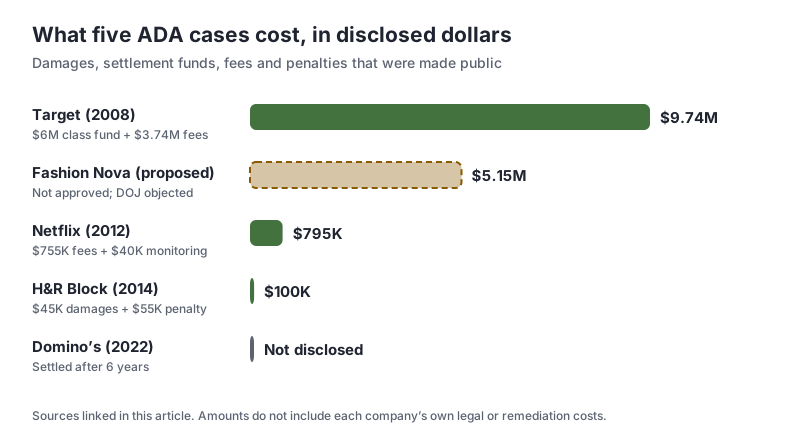
| Case | Year resolved | Payout | Who got it |
|---|---|---|---|
| NFB v. Target | 2008 | About $9.74 million | Class members, a nonprofit, plaintiffs’ lawyers |
| Alcazar v. Fashion Nova | Proposed, not approved | $5.15 million | California class members, lawyers |
| NAD v. Netflix | 2012 | $795,000 | Plaintiffs’ lawyers, monitoring |
| U.S. v. H&R Block | 2014 | $100,000 | Two plaintiffs, the government |
| Robles v. Domino’s | 2022 | Not disclosed | Confidential |
1. NFB v. Target: About $9.74 Million
The National Federation of the Blind sued Target in 2006 because blind shoppers could not use its website with screen readers. The class action settled in August 2008. Target set up a $6 million fund for California class members, with up to $7,000 per claimant, paid $20,000 to the California Center for the Blind, and paid $3,738,864.96 in the plaintiffs’ attorney fees and costs. It agreed to make the site accessible by early 2009 and to three years of monitoring by the NFB, without admitting it broke the law (W3C WAI case study).
Why it was so large: it was a class action under California law, where each class member could claim statutory damages, and it was fought for more than two years.
2. Alcazar v. Fashion Nova: $5.15 Million Proposed
A class action against clothing retailer Fashion Nova, filed in 2020 in the Northern District of California. The parties proposed a $5.15 million settlement, with payments of up to $4,000 per California class member under the Unruh Act. In February 2026 the Department of Justice opposed it, saying it had no concrete commitment to fix the website, no monitoring and no enforcement, and that the attorney fees were out of proportion (Seyfarth Shaw). It had not been finally approved when this was written.
Why it matters: a big payout without a real fix is now being challenged. Paying money does not replace fixing the site. More on this case in our roundup of 2026 ADA lawsuits.
3. NAD v. Netflix: $795,000
The National Association of the Deaf sued Netflix in 2011 over missing captions on streamed movies and shows. Under the October 2012 consent decree, Netflix paid $755,000 in attorney fees and costs and $40,000 toward monitoring, and agreed to caption 100% of its streamed content by September 30, 2014 (consent decree, via DREDF).
Why it was smaller: it was not a damages class action, so almost all of the money went to fees. The bigger cost for Netflix was the captioning itself.
4. U.S. v. H&R Block: $100,000
The Department of Justice joined a lawsuit against H&R Block in December 2013 over its website, online tax software and mobile apps. Under the 2014 consent decree, H&R Block paid $45,000 to the two individual plaintiffs and a $55,000 civil penalty, and agreed to make its site and apps conform to WCAG 2.0 Level AA, under a five-year decree (Department of Justice).
Why it matters: this is what the DOJ’s involvement looks like. A civil penalty is possible, and a named technical standard, WCAG, goes into the agreement.
5. Robles v. Domino’s: Not Disclosed
Guillermo Robles, who is blind, sued Domino’s in 2016 after being unable to order on its website and app with a screen reader. The case went to the Ninth Circuit and the Supreme Court declined to hear Domino’s appeal in 2019. The parties settled in June 2022 on confidential terms.
Why it matters: many ADA lawsuit payouts are never made public, especially for small businesses. Be wary of any article that quotes a precise “average ADA settlement” without a source. Read how long an ADA lawsuit takes to see how the Domino’s case stretched to nearly six years.
What Drives the Size of an ADA Lawsuit Payout
From these five ADA lawsuit payouts, a few factors stand out:
- Where you are sued. States with damages laws, above all California, raise the stakes.
- Class action or single plaintiff. Damages multiply across a class. Most small-business cases are single plaintiffs, which keeps the number much lower.
- How long it is fought. Every month of litigation adds attorney fees on both sides.
- Whether the DOJ is involved. That can add civil penalties.
- Whether the site gets fixed. A real fix gives your lawyer something to offer and, as in Jones v. Moscot in 2026, can even end the federal claim.
The payouts above are also not the full cost. The business pays its own lawyers, the cost of fixing the site, and often the cost of monitoring. For a fuller picture of what happens after you are sued, see what happens after being sued for ADA website compliance.
How To Keep Your ADA Lawsuit Payout at Zero
The cheapest ADA lawsuit is the one that is never filed, and the second cheapest is the one settled early because the site is already being fixed. Both start with knowing what is wrong.
Run the free ADA compliance checker on your home page and key templates. It tests against WCAG 2.1 Level AA, the standard used in ADA settlements like H&R Block’s, and lists every issue automated testing can find, ranked by severity, with how to fix it. If you have already been served, follow our step-by-step guide on what to do after an ADA lawsuit, then fix your website after the ADA lawsuit in the right order.
To stay ahead, AccessBell’s continuous monitoring rescans your pages every day and alerts you to new serious issues, and the Compliance Vault keeps a dated record of your fixes. No tool can make a website 100% compliant or guarantee you will never be sued. What it can do is help you find and fix problems before a plaintiff’s lawyer finds them first.
Frequently Asked Questions
How much is a typical ADA lawsuit payout?
There is no reliable public average, because most small-business ADA settlements are private. What the law sets is the structure: under federal ADA Title III, a private plaintiff can win a court order to fix the barriers and attorney fees, but not money damages. Money for the plaintiff comes from state laws like California's Unruh Act, which allows $4,000 per violation.
Can you get money from an ADA lawsuit?
Not under the federal ADA alone, for private Title III lawsuits. The law allows a court order to fix the barriers and attorney fees. State laws can add damages, and the Department of Justice can seek civil penalties when it brings or joins a case.
What was the largest website ADA lawsuit payout?
Among well-known website cases, NFB v. Target (2008) is one of the largest: a $6 million class fund plus about $3.74 million in attorney fees. A $5.15 million settlement was proposed in Alcazar v. Fashion Nova but had not been finally approved as of October 2026.
Who pays the attorney fees in an ADA lawsuit?
If the plaintiff wins or the settlement provides for it, the business usually pays the plaintiff's attorney fees, on top of its own legal costs. In many website cases the fees are the largest part of the payout.
How we reviewed this article
- Current version
First published. Amounts checked against the settlement agreements and consent decrees, the Department of Justice and the Seyfarth Shaw ADA Title III blog. Only publicly reported figures are included.