ADA Lawsuit Process: How Long Does It Take in 2026?
How long does an ADA lawsuit take? The court deadlines in the ADA lawsuit process, the federal median, and how long five real website cases took from filing to end.
Table of contents
The ADA lawsuit process can be over in a few weeks or drag on for years. How long it takes depends mostly on one decision: whether the case settles early or is fought. This guide answers how long an ADA lawsuit takes in 2026, using the deadlines set by the federal court rules, the federal court statistics, and five real website cases with known start and end dates.
This is general information, not legal advice. Your lawyer can tell you what to expect in your court.
For what happens at each stage, read our full guide to the ADA lawsuit process. This post focuses on time.
The Short Answer: How Long an ADA Lawsuit Takes
- Settled early: most website ADA lawsuits against small businesses settle, many before the business has to file a full defense or start discovery. These can be over in weeks or a few months.
- Fought in federal court: the median federal civil case took 15.6 months from filing to disposition in the 12 months to September 30, 2025 (U.S. Courts, Table C-5). That figure covers all civil cases, not just ADA cases, so treat it as a rough guide.
- Appealed or a class action: years. The best-known website cases took between 16 months and more than six years.
ADA Lawsuit Process Deadlines Set by the Court Rules
Some parts of the ADA lawsuit process run on fixed clocks. In federal court, these come from the Federal Rules of Civil Procedure and the Federal Rules of Appellate Procedure.
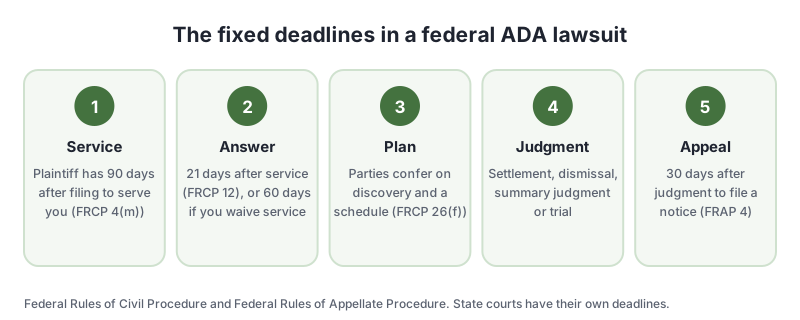
| Stage | Deadline | Rule |
|---|---|---|
| Plaintiff serves the complaint | Within 90 days of filing | FRCP 4(m) |
| You answer or file a motion | 21 days after service, or 60 days if you waived service | FRCP 12 |
| Parties plan discovery | Set by the court’s schedule | FRCP 26(f) |
| Appeal after judgment | 30 days | FRAP 4 |
The 21-day deadline is the one that matters most to you. It starts when you are served, not when you read the papers. If you were just served, follow our guide to what to do after an ADA lawsuit, starting with putting that date on your calendar.
Everything between these deadlines, such as motions, discovery and mediation, runs on the court’s schedule and the parties’ choices. That is where months turn into years.
How Long Real ADA Lawsuits Took
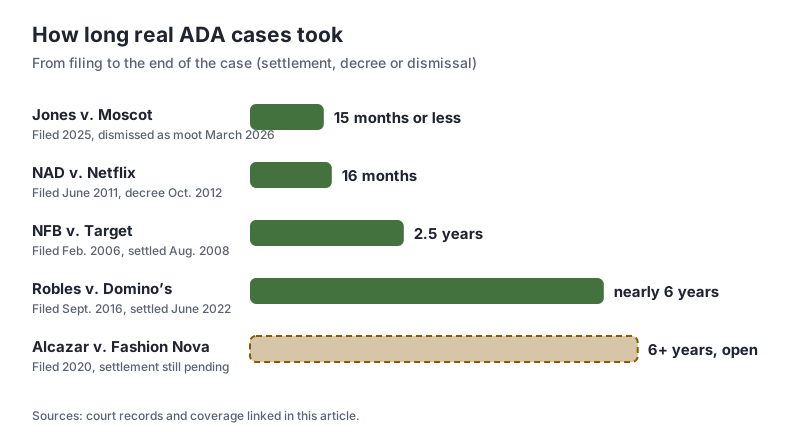
These five website cases are well documented, with public start and end dates. They are not typical: most small-business cases settle quietly and quickly. They show how long an ADA lawsuit can take when it is fought.
Jones v. Moscot: About a Year, Ended by a Fix
Filed in the Southern District of New York in 2025 and dismissed on March 5, 2026. The business fixed its website, proved it with a declaration and a report from an accessibility firm, and the court dismissed the federal claim as moot (Seyfarth Shaw). Read more in our roundup of 2026 ADA lawsuits.
NAD v. Netflix: 16 Months
The National Association of the Deaf sued Netflix on June 16, 2011, over missing captions on streamed video. In June 2012 the court ruled the streaming service could be covered by the ADA, and the parties signed a consent decree on October 9, 2012, about 16 months after filing. Netflix agreed to caption all streamed content by September 30, 2014.
NFB v. Target: About 2.5 Years
The National Federation of the Blind sued Target on February 7, 2006, over its website. The case became a class action and settled on August 27, 2008. Target agreed to make the site accessible by early 2009 and accept three years of monitoring.
Robles v. Domino’s: Nearly Six Years
Guillermo Robles, who is blind, sued Domino’s in September 2016 after being unable to order a pizza on its website and app with a screen reader. The case went to the Ninth Circuit, which ruled for Robles in January 2019, and Domino’s asked the Supreme Court to hear it. The Supreme Court declined in October 2019, and the case went back to the trial court. A settlement was announced in June 2022, nearly six years after filing. The terms were not made public.
Alcazar v. Fashion Nova: More Than Six Years and Counting
Filed in the Northern District of California in 2020 as a class action. A $5.15 million settlement was proposed, and in February 2026 the Department of Justice opposed it because it had no concrete commitment to fix the website (Seyfarth Shaw). The case was still open when this was written.
See what each of these cases cost in our guide to ADA lawsuit payouts.
What Makes the ADA Lawsuit Process Take Longer
From the cases above, a few things add the most time:
- Fighting whether the ADA applies. Domino’s spent years arguing that its website was not covered. Courts still disagree in some parts of the country, but it is an expensive argument to make.
- Class actions. Target and Fashion Nova were class actions. They need court approval at several steps, and settlements can be challenged, as the DOJ did in Fashion Nova.
- Appeals. An appeal adds a year or more.
- Discovery. Once the parties start exchanging documents and taking depositions, costs and time climb fast.
What Makes an ADA Lawsuit End Sooner
- Responding on time and getting a lawyer involved in the first week.
- Fixing the website early. It gives you something real to offer in a settlement, and in some cases, like Moscot, it ends the federal claim.
- Having a dated record of the work. Proof of what you fixed and when shortens the argument about it. See what goes into an ADA compliance report for your lawyer.
Shorten Your ADA Lawsuit by Starting the Fix Today
The fastest way through the ADA lawsuit process is to know exactly what is wrong with your website and fix it. Run the free ADA compliance checker on the pages named in the complaint. It tests against WCAG 2.1 Level AA and lists every issue automated testing can find, ranked by severity, with how to fix it. Automated testing does not catch everything, so read our guide to automated vs. manual accessibility testing for the checks that need a person.
AccessBell’s Compliance Vault then keeps a dated record of every scan and fix to share with your lawyer. No tool can make a site 100% compliant or end a lawsuit on its own, but a tested and documented fix is what shortens one.
Frequently Asked Questions
How long does an ADA lawsuit take?
Most website ADA lawsuits against small businesses settle within months, often before discovery. Cases that are fought take much longer: the median federal civil case took 15.6 months from filing to disposition in the year to September 30, 2025, and well-known website cases have lasted from 16 months to more than six years.
How long do I have to respond to an ADA lawsuit?
In federal court, 21 days after being served, or 60 days if you agreed to waive formal service. State courts set their own deadlines.
What makes an ADA lawsuit take longer?
Fighting the case instead of settling, discovery, class actions, appeals, and disputes over whether websites are covered by the ADA at all. Robles v. Domino's took nearly six years largely because it went to the Ninth Circuit and the Supreme Court was asked to hear it.
Can an ADA lawsuit end quickly?
Yes. Many settle within weeks or a few months. A case can also end early if the court dismisses it, for example because the website was fixed and the claim is moot, as in Jones v. Moscot in 2026.
How we reviewed this article
- Current version
First published. Deadlines checked against the Federal Rules of Civil Procedure and the Federal Rules of Appellate Procedure. Case dates checked against court filings, consent decrees and the Seyfarth Shaw ADA Title III blog. The federal median comes from U.S. Courts Table C-5.