Got an ADA Lawsuit in 2026? What To Do Next, Step by Step
Just served with an ADA lawsuit over your website? What to do in the first week, step by step: deadlines, your lawyer, your insurer, evidence and fixing the site.
Table of contents
If you just got an ADA lawsuit over your website, the first week matters more than any other. This guide walks you through what to do next, in order, from the moment you are served to the point where you and your lawyer pick a strategy. It is written for small and mid-size business owners, especially online stores, which are the most common targets.
This is general information, not legal advice. Every case is different, and you need a lawyer who defends ADA cases.
First, Confirm It Is Really an ADA Lawsuit
An ADA lawsuit comes as a summons and complaint filed with a court. It names the court, a case number and you (or your company) as the defendant. If what you received is a letter from a law firm asking for money but with no case number, it is a demand letter, not a lawsuit yet. Read our guide to what to do after an ADA demand letter instead.
Most website cases are brought under Title III of the Americans with Disabilities Act, which covers businesses open to the public. Our guide to ADA Title III law for businesses explains who it covers.
Your First Week After an ADA Lawsuit, Step by Step
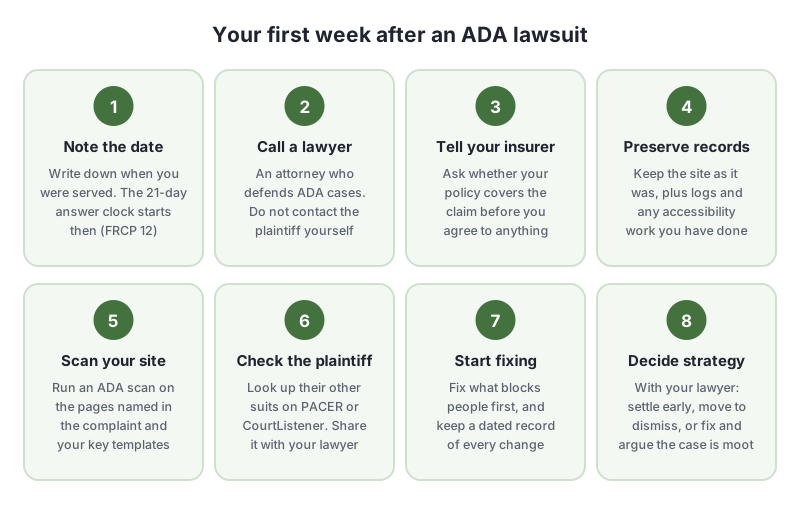
Step 1: Write Down the Date You Were Served
In federal court you have 21 days after being served to file an answer or a motion, under Federal Rule of Civil Procedure 12. If you agreed to waive formal service, you get 60 days from the date the waiver request was sent. State courts have their own deadlines. Missing the deadline can lead to a default judgment, so put the date on your calendar before you do anything else.
Step 2: Call a Lawyer Who Defends ADA Cases
This is the most important step. A lawyer who regularly defends ADA website cases knows the plaintiff firms, what similar cases settled for in your court, and which defenses work there. Do not contact the plaintiff or their lawyer yourself, and do not post about the lawsuit.
Step 3: Tell Your Insurance Company
Some business insurance policies cover part of the defense costs of an ADA lawsuit, and many do not. Send the complaint to your broker or insurer right away and ask whether it is covered. Late notice can affect coverage, so do not wait until you have decided what to do.
Step 4: Preserve Your Records
Do not delete pages, change hosting or wipe analytics to make the problem disappear. Keep a copy of the site as it was, along with any accessibility work you have already done, such as earlier audits, bug tickets or fixes. If you have been running scans, export them. A dated history of real accessibility work helps your lawyer. See what goes into an ADA compliance report for your lawyer.
Step 5: Scan Your Website for the Issues in the Complaint
Most complaints list specific barriers: images with no alt text, form fields with no labels, buttons a screen reader cannot name, or a checkout that cannot be used with a keyboard. Run the free ADA compliance checker on the pages named in the complaint, your home page and your key templates, such as a product page and checkout. You get a list of the issues automated testing can find, ranked by severity, against WCAG 2.1 Level AA, the benchmark used in ADA website cases.
Automated testing does not cover everything. Our guide on how to check if your website is ADA compliant covers the manual checks, such as using the site with only a keyboard.
Step 6: Look Up the Plaintiff’s Other Lawsuits
Many website cases are filed by the same plaintiffs and firms against dozens of businesses. You can search federal dockets on PACER or the free CourtListener database. Give what you find to your lawyer. Courts have started to look harder at serial filings: in February 2026, Judge Jeannette Vargas in the Southern District of New York ordered discovery and a hearing on whether the plaintiff in Fernandez v. Cuddle Clones had really tried to buy from the site, after noting more than 57 similar suits (Seyfarth Shaw).
Step 7: Start Fixing the Website, and Keep a Dated Record
Fixing the barriers is the one step that helps in every outcome. It lowers the cost of a settlement, it can support a mootness defense, and it stops the next lawsuit, because businesses that have been sued once are often sued again.
Start with whatever blocks someone from finishing a task: missing labels in checkout, unnamed buttons, images without alt text and low color contrast. Keep a dated log of every fix. Our guide on how to fix your website after an ADA lawsuit covers the order and the code.
Step 8: Decide Your Strategy With Your Lawyer
By the end of the first week you and your lawyer can choose a path. The usual options are:
- Settle early. Often the cheapest route, especially before discovery starts. Expect the settlement to include a commitment to fix the site by a deadline.
- Fix the site and argue the claim is moot. Federal Title III claims ask for the barriers to be fixed. If you can prove they are fixed and will stay fixed, a court can dismiss the claim. In March 2026, Judge J. Paul Oetken dismissed Jones v. Moscot in the Southern District of New York on that basis, relying on a declaration and an accessibility vendor’s report that the plaintiff did not dispute (Seyfarth Shaw). The bar is high: the court required it to be “absolutely clear” the site would stay accessible.
- Challenge standing or jurisdiction. If the plaintiff never really tried to use your site, or your business has no connection to the court where you were sued, your lawyer may move to dismiss.
Our guide to the ADA lawsuit process explains what happens at each stage after this, and how long an ADA lawsuit takes covers the timeline.
What Not To Do After an ADA Lawsuit
- Do not ignore it. A default judgment is usually worse than any settlement.
- Do not install an overlay widget and call it fixed. Overlays do not change your code. In 2025 the Federal Trade Commission ordered overlay vendor accessiBe to pay $1 million over misleading claims about its product (Seyfarth Shaw). See accessiBe vs. AccessBell.
- Do not promise anything in writing to the plaintiff without your lawyer.
If Your Business Is in Missouri, California or New York
Where you were sued changes the rules:
- Missouri passed a law in May 2026, effective August 28, 2026, that lets a Missouri defendant sue over an abusive website accessibility lawsuit and recover fees (Seyfarth Shaw).
- California lets plaintiffs seek statutory damages under the Unruh Act on top of the federal claim. See California website accessibility law.
- New York federal courts have tightened standing for repeat plaintiffs, which has pushed some cases into state court. See New York website accessibility law.
How To Avoid the Next ADA Lawsuit
Once the case is resolved, the goal is not to be sued again. That means fixing the code, checking new pages as you publish them, and keeping proof. AccessBell helps you do all three: continuous monitoring rescans up to 500 pages per domain on a schedule and emails you when a new serious issue appears, and the Compliance Vault keeps a dated record of every scan and fix that you can hand to your lawyer.
No tool can make a website 100% compliant or guarantee you will not be sued. But a site that has been tested, fixed and monitored is a much harder target. Start now: run the free ADA compliance checker on the pages named in your complaint.
Frequently Asked Questions
How long do I have to respond to an ADA lawsuit?
In federal court, 21 days after you are served with the summons and complaint, or 60 days if you agreed to waive formal service. State courts set their own deadlines, so check the summons and ask your lawyer on day one.
Should I call the person who sued me?
No. Let your lawyer handle all contact. Anything you say can end up in the case, and a quick promise or an argument can make the case harder to resolve.
Can fixing my website end an ADA lawsuit?
Sometimes. Federal ADA Title III claims ask a court to order the barriers fixed, so if you can prove the site is now accessible and will stay that way, a court may dismiss the claim as moot. In 2026 a New York federal court did exactly that in Jones v. Moscot. It does not end state-law damages claims or the plaintiff's claim for attorney fees on its own.
Will an accessibility overlay make the lawsuit go away?
No. Overlays sit on top of your site and do not change the code that plaintiffs test. In 2025 the FTC ordered overlay vendor accessiBe to pay $1 million over misleading claims about what its tool could do.
Is an ADA lawsuit the same as a demand letter?
No. A demand letter is a warning before anyone files in court. An ADA lawsuit has been filed with a court and comes with a summons and a deadline to respond.
How we reviewed this article
- Current version
First published. Deadlines checked against the Federal Rules of Civil Procedure. Case examples checked against the court orders and the Seyfarth Shaw ADA Title III blog.