2026 ADA Lawsuits: Recent Cases and How To Maneuver Them
ADA lawsuits in 2026: the filing numbers, four recent website cases (Moscot, Cuddle Clones, Fashion Nova, Missouri) and what each teaches a business that is sued.
Table of contents
ADA lawsuits are back on the rise in 2026. Federal filings in the first half of the year were the highest in years, website cases now make up more than a third of all Title III suits, and the courts have handed down some decisions that change how a business can fight back. This guide covers the 2026 numbers, four recent cases, and how to maneuver an ADA lawsuit if your business is the next one sued.
This is general information, not legal advice. Talk to a lawyer who defends ADA cases about your situation.
ADA Lawsuits in 2026 by the Numbers
Seyfarth Shaw, a law firm that tracks federal ADA Title III filings, counted 5,006 federal Title III lawsuits in the first six months of 2026. The average for the first half of the previous four years was 4,463. Seyfarth said the full year could pass 10,000 for the first time since the record of 11,452 in 2021 (Seyfarth Shaw, 2026 mid-year report).
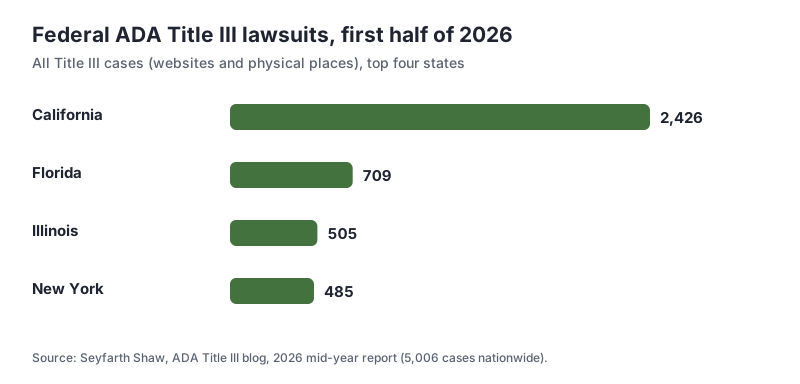
California alone accounted for almost half of the federal total. New York, long the center of website lawsuits, fell to fourth after its federal courts got stricter about standing, which has pushed many website cases into New York state courts instead, where they do not appear in federal counts.
Website ADA Lawsuits Are a Growing Share
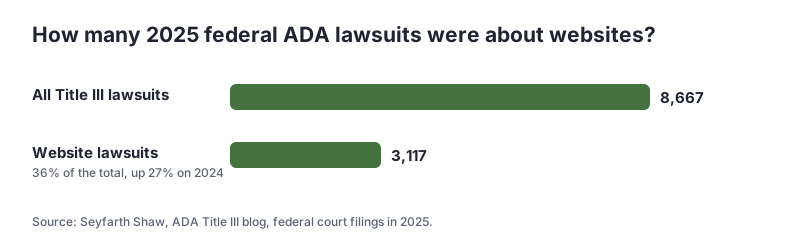
These numbers include every kind of Title III case: parking lots, restrooms and ramps as well as websites. Website cases are a big and growing part of them. In 2025, 3,117 of the 8,667 federal Title III lawsuits were about websites, about 36%, and website filings were up 27% from 2024 (Seyfarth Shaw).
Small businesses are the main target. UsableNet found that 64% of companies sued in the first half of 2025 had annual revenue under $25 million (UsableNet). Most are online stores, restaurants and service businesses, not big brands.
Four Recent ADA Lawsuits and What They Teach
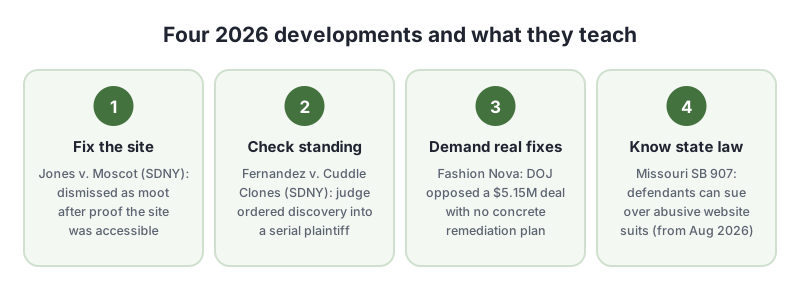
The numbers tell you how likely an ADA lawsuit is. The cases tell you what to do about one. These four, from late 2025 and 2026, each show a different way a business can maneuver.
1. Jones v. Moscot: Fixing the Website Ended the Federal Claim
Eyewear company Moscot was sued in the Southern District of New York in 2025 over its website (Jones v. Moscot.com, LLC, No. 25-cv-1843). Moscot fixed the site and backed it up with evidence: a sworn declaration from an e-commerce executive and a report from accessibility firm Level Access. The plaintiff did not offer evidence to dispute it.
On March 5, 2026, Judge J. Paul Oetken dismissed the federal ADA claim as moot. Because private plaintiffs under Title III can only ask a court to order the barriers fixed, there was nothing left to order. The bar was high: the court required it to be “absolutely clear” that the website was accessible and would stay that way. The dismissal was without prejudice, and the plaintiff’s state-law claim could be refiled in state court (Seyfarth Shaw).
The lesson: fixing your website is a legal strategy, not just good practice. But the fix has to be real, tested and documented, with a plan to keep it that way.
2. Fernandez v. Cuddle Clones: Courts Are Questioning Serial Plaintiffs
Cuddle Clones, which makes plush toys that look like customers’ pets, was sued in the same court (Fernandez v. Cuddle Clones, LLC, No. 1:25-cv-01837). The plaintiff claimed they tried to buy a custom plush but could not use the site with a screen reader.
On February 12, 2026, Judge Jeannette Vargas ordered jurisdictional discovery and an evidentiary hearing on whether the plaintiff had standing. The judge pointed to more than 57 website lawsuits the plaintiff had filed, a series of attempted purchases from different sites within four days, and complaints that were nearly identical to each other (Seyfarth Shaw). The outcome was not public when this was written.
The lesson: look up who sued you. If the plaintiff has filed dozens of near-identical cases, your lawyer may be able to challenge whether they ever really meant to use your site.
3. Alcazar v. Fashion Nova: A Big Settlement Without Real Fixes Ran Into the DOJ
The class action against clothing retailer Fashion Nova was filed in 2020 in the Northern District of California (Alcazar v. Fashion Nova, No. 4:20-cv-01434). The parties proposed a $5.15 million settlement, with payments of up to $4,000 for California class members under the state’s Unruh Act.
In February 2026, the Department of Justice filed a statement of interest opposing it. The DOJ said the settlement had no concrete commitment to fix the website, no monitoring and no way to enforce it, that the attorney fees were out of proportion, and that the settlement’s own website was not accessible (Seyfarth Shaw). The settlement had not been finally approved when this was written.
The lesson: a settlement that pays money but does not fix the website does not solve the problem. Courts and the DOJ expect a real fix. Read more about ADA lawsuit payouts and what drives them.
4. Missouri SB 907: A State Law That Lets Businesses Fight Back
In May 2026, Missouri passed the Act Against Abusive Website or Web Content Access Litigation, which took effect on August 28, 2026. It lets a Missouri business that is sued in an abusive website accessibility lawsuit sue the plaintiff and their lawyers, and the state Attorney General can also act. A suit is presumed abusive if the business got written notice of the problem and started substantial fixes within 90 days. Remedies include attorney fees and up to three times those fees (Seyfarth Shaw).
Kansas passed a similar law in 2023. Missouri had 70 federal Title III suits in the first half of 2026, so the law’s real effect is not yet known.
The lesson: in a growing number of states, a business that acts quickly on a notice is in a much stronger position. Acting fast is what the law rewards.
How To Maneuver an ADA Lawsuit in 2026
Put these cases together and a clear playbook comes out of them. If you are sued, or think you might be:
- Respond on time. In federal court you have 21 days after being served. Our step-by-step guide covers what to do after an ADA lawsuit in the first week.
- Get a lawyer who defends ADA cases. They know the plaintiff firms and which defenses work in your court.
- Check the plaintiff’s history. Search their other cases on CourtListener. Cuddle Clones shows why it matters.
- Fix the site and document every fix. Moscot shows this can end the federal claim. Missouri shows states are rewarding it. Even when it does not end the case, it lowers the cost and protects you from the next one.
- Do not rely on an overlay. In 2025 the FTC ordered overlay vendor accessiBe to pay $1 million over misleading claims about what its tool could do (Seyfarth Shaw). See accessiBe vs. AccessBell.
- Know your timeline. Read how long an ADA lawsuit takes and the stages of the ADA lawsuit process.
What Public Entities Should Know About 2026 ADA Lawsuits
State and local governments are covered by Title II of the ADA, not Title III. In April 2026, the DOJ extended the deadlines in its Title II web accessibility rule to April 26, 2027 for large entities and April 26, 2028 for smaller ones. Disability groups have challenged the extension. Our guide to ADA Title II website compliance has the details.
Where To Start Before an ADA Lawsuit Finds You
Every case above turns on the same question: what is actually wrong with the website, and has it been fixed? You can answer the first part in a couple of minutes. Run the free ADA compliance checker on your home page. It tests the page against WCAG 2.1 Level AA, the standard used in ADA website cases, and lists every issue automated testing can find, ranked by severity, with how to fix it.
To keep it fixed, AccessBell’s continuous monitoring rescans your pages every day and emails you when a new serious issue appears, and the Compliance Vault keeps the dated record of your work that a case like Moscot depends on. No tool makes a website 100% compliant or guarantees you will never be sued, but a tested, fixed and documented site is the strongest position you can be in. If you are in a high-volume state, read about California, Florida and New York website accessibility law.
Frequently Asked Questions
How many ADA lawsuits were filed in 2026?
Seyfarth Shaw counted 5,006 federal ADA Title III lawsuits in the first half of 2026, above the average of 4,463 for the first half of the previous four years. At that pace, the full year could pass 10,000.
Which state has the most ADA lawsuits in 2026?
California, by a wide margin: 2,426 federal Title III suits in the first half of 2026, followed by Florida (709), Illinois (505) and New York (485).
How many ADA lawsuits are about websites?
In 2025, 3,117 of 8,667 federal Title III lawsuits (about 36%) were about websites, up 27% from the year before, according to Seyfarth Shaw. Many more website cases are filed in state courts and are not in that count.
Can a website ADA lawsuit be dismissed if the site is fixed?
It can. In Jones v. Moscot (S.D.N.Y., March 2026), the court dismissed the federal claim as moot because the business proved, with evidence the plaintiff did not dispute, that its website was accessible and would stay that way.
What is the Missouri ADA website lawsuit law?
A 2026 Missouri law, effective August 28, 2026, lets a Missouri business sued in an abusive website accessibility lawsuit sue the plaintiff and their lawyers. A suit is presumed abusive if the business got written notice and started substantial fixes within 90 days.
How we reviewed this article
- Current version
First published. Filing numbers come from the Seyfarth Shaw 2025 year-end and 2026 mid-year reports. Case details come from the court orders as reported by Seyfarth Shaw.